Soy sauce is a dark, salty fermented condiment made from four ingredients — soybeans, wheat, salt, and water — plus the koji mold culture that ferments them. Traditional brewing uses the soybeans and the wheat in roughly equal parts by weight: the soybeans are steamed, while the wheat is roasted and cracked (Chinese brewers often use wheat flour instead). Cracking opens the wheat's starch to the mold, and roasting it also holds back bacteria that would otherwise spoil the mash. The salt is dissolved into a brine of about 18 percent sodium chloride — a concentration at which only salt-tolerant organisms can work. The water is simply the medium the whole process moves through. Each ingredient has a job that is still legible in the bottle: the soybeans supply the protein that becomes amino acids and the sauce's savory depth. The roasted wheat supplies the sugars that feed the fermentation and the color of the finished liquid. The salt carries the flavor and preserves the mash, and the water carries everything else. Traditional brewing needs nothing more. The main varieties are defined by adjusting this list rather than replacing it; tamari, for instance, is brewed with little or no wheat. And the salt left in the bottle is what dominates its nutrition: USDA nutrient data for brewed soy sauce (shoyu) lists about 5,500 milligrams of sodium per 100 grams, roughly 14 percent of the sauce's weight as salt.
Soy sauce is fermented in two stages, and only the second one yields liquid sauce. In the first, steamed soybeans and roasted cracked wheat are inoculated with Aspergillus oryzae — or the closely related A. sojae — and held warm and humid while the mold grows through the mixture and secretes proteases and amylases. Those enzymes are the engine of the process, and they are not spent when the koji stage ends. In the second stage the koji is submerged in brine to make a mash called moromi, and over the following months the enzymes keep breaking soybean protein down into peptides and then into free amino acids, while wheat starch becomes simple sugars. The amino acid that matters most is glutamic acid: the proteases release it, and the enzyme glutaminase converts glutamine into more of it, so that its concentration — not salt alone — is what makes soy sauce taste savory rather than merely salty. Running alongside that, alcohol and organic-acid fermentation in the mash produces the ethanol, lactic acid, and acetic acid behind much of the sauce's aroma and tartness, while reactions between amino acids and sugars generate the roasted, caramel-like pyrazines and furans that mark a long-fermented sauce. Salt is the regulator that makes all of this possible. At brine strength it favors salt-tolerant organisms and holds back the ones that would spoil an open mash — the same selectivity that the FAO fermented-foods review documents for salt-tolerant lactic acid bacteria. Salt also slows the enzymes down: protease activity in 18 percent salt falls to a few percent of its unbrined rate. That is why the process takes months rather than days. The mash works slowly through those months, and the brewing is typically left to ferment for eight months to a year. The mature mash is then pressed to extract the liquid, which is pasteurized and filtered before bottling. A few specialty sauces are aged far longer.
China is the birthplace of soy sauce, with the earliest known reference dating to the Western Han dynasty (202 BCE-9 CE), where a fermented soybean paste called jiang (酱) was recorded. By the Song dynasty (960-1279 CE), a liquid form of jiang—jiàngyōu—appeared. Soy sauce was transmitted to Japan by Buddhist monks in the 7th century CE, where it evolved into shōyu—a lighter, more refined product than the Chinese version. Japan's soy sauce production was industrialized in the 17th century, giving rise to major producers like Kikkoman.
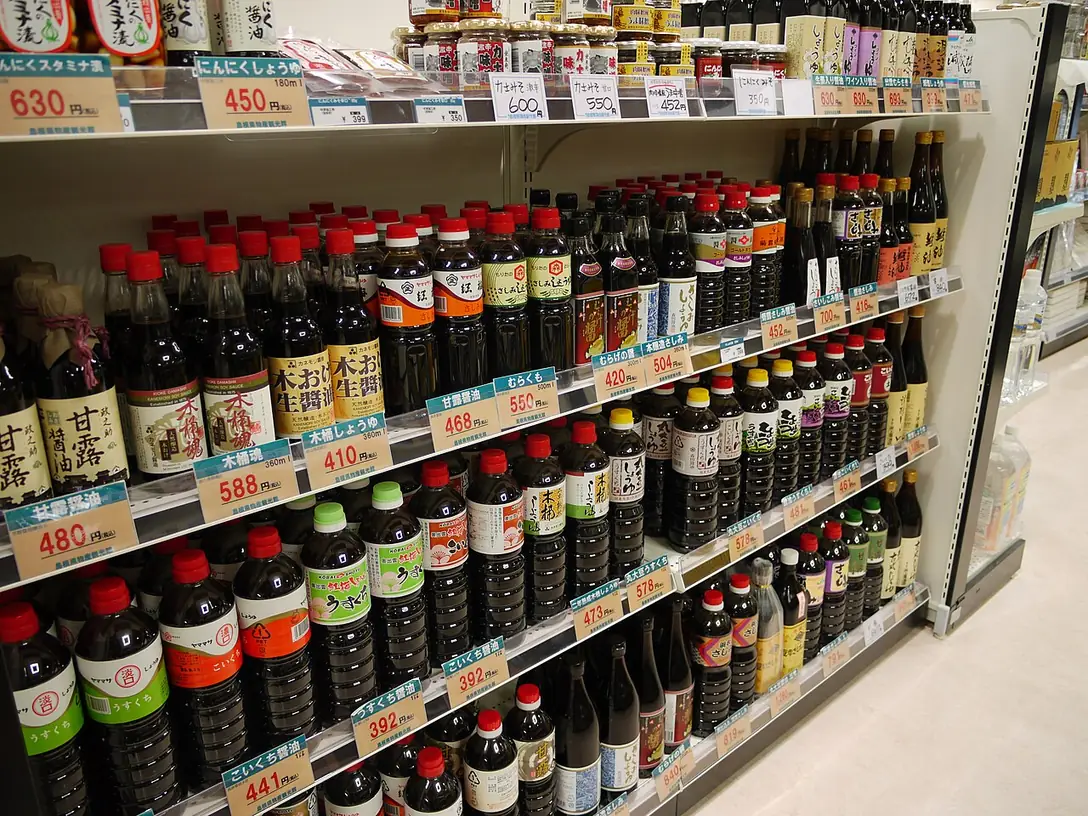
The diversity of soy sauces in East Asia is remarkable. Chinese soy sauces range from light (生抽, shēngchōu), a thinner, saltier sauce used daily for cooking, to dark (老抽, lǎochōu), a thicker, sweeter, less salty sauce aged longer and used for color and depth in braised dishes. Tamari (たまり) is a Japanese soy sauce made with little or no wheat, resulting in a thicker texture and richer umami. Usukuchi (薄口) is a light-colored Japanese soy sauce with higher salt content, used to preserve the natural colors of ingredients. Korean ganjang (간장) has its own classification system, with soup soy sauce (국간장, guk-ganjang) being lighter and soup-grade, and regular soy sauce (양조간장, yangjo-ganjang) spanning various quality levels.